Twin City
Twin City
Redesigning a Home Swapping App
to Help Creatives Travel Freely
Redesigning a Home Swapping App to Help Creatives Travel Freely
Redesigning a Home Swapping
App to Help Creatives Travel Freely
Role
Role
UX/UI Designer
User Research
No Code Developer
UX/UI Designer
User Research
No Code Developer
UX/UI Designer
User Research
No Code Developer
Timeline
Timeline
March - June 2025
March - June 2025
March - June 2025
Tools
Tools
Figma
Bubble
Figma
Bubble
Figma
Bubble
Solo Project
Solo Project
The Background
The Idea Worked But the Experience Didn’t…
The Idea Worked But the
Experience Didn’t…
The Idea Worked
But the Experience Didn’t…
Twin City is a home-swapping startup for creatives, helping members travel without paying for accommodation. The MVP gained early traction, with over 3,000 users and features in Condé Nast and Elle. However, most users couldn’t complete a swap. Without successful swaps, the freemium model stalled and investor conversations paused. Fixing the core experience became critical before momentum disappeared.
Twin City is a home-swapping startup for creatives, helping members travel without paying for accommodation. The MVP gained early traction, with over 3,000 users and features in Condé Nast and Elle.
However, most users couldn’t complete a swap. Without successful swaps, the freemium model stalled and investor conversations paused. Fixing the core experience became critical before momentum disappeared.
Twin City is a home-swapping startup for creatives, helping members travel without paying for accommodation. The MVP gained early traction, with over 3,000 users and features in Condé Nast and Elle.
However, most users couldn’t complete a swap. Without successful swaps, the freemium model stalled and investor conversations paused. Fixing the core experience became critical before momentum disappeared.
The Problem
Most Users Couldn't Book Home Swaps
Most Users Couldn't
Book Home Swaps

Our dates never match.
It's constant calendar Tetris
Our dates never match.
It's constant calendar Tetris
I just message everyone in the city
and hope someone says yes
I just message everyone in the city
and hope someone says yes

Users were excited to use Twin City but rarely found available swap partners. The main friction was aligning travel dates, members struggled to find overlapping plans. The issue wasn’t a lack of compatible members. The MVP failed to guide users toward viable matches, driven by three underlying problems:
Users were excited to use Twin City but rarely found available swap partners. The main friction was aligning travel dates, members struggled to find overlapping plans.
The issue wasn’t a lack of compatible members. The MVP failed to guide users toward viable matches, driven by three underlying problems:
Unguided Search
Unguided Search
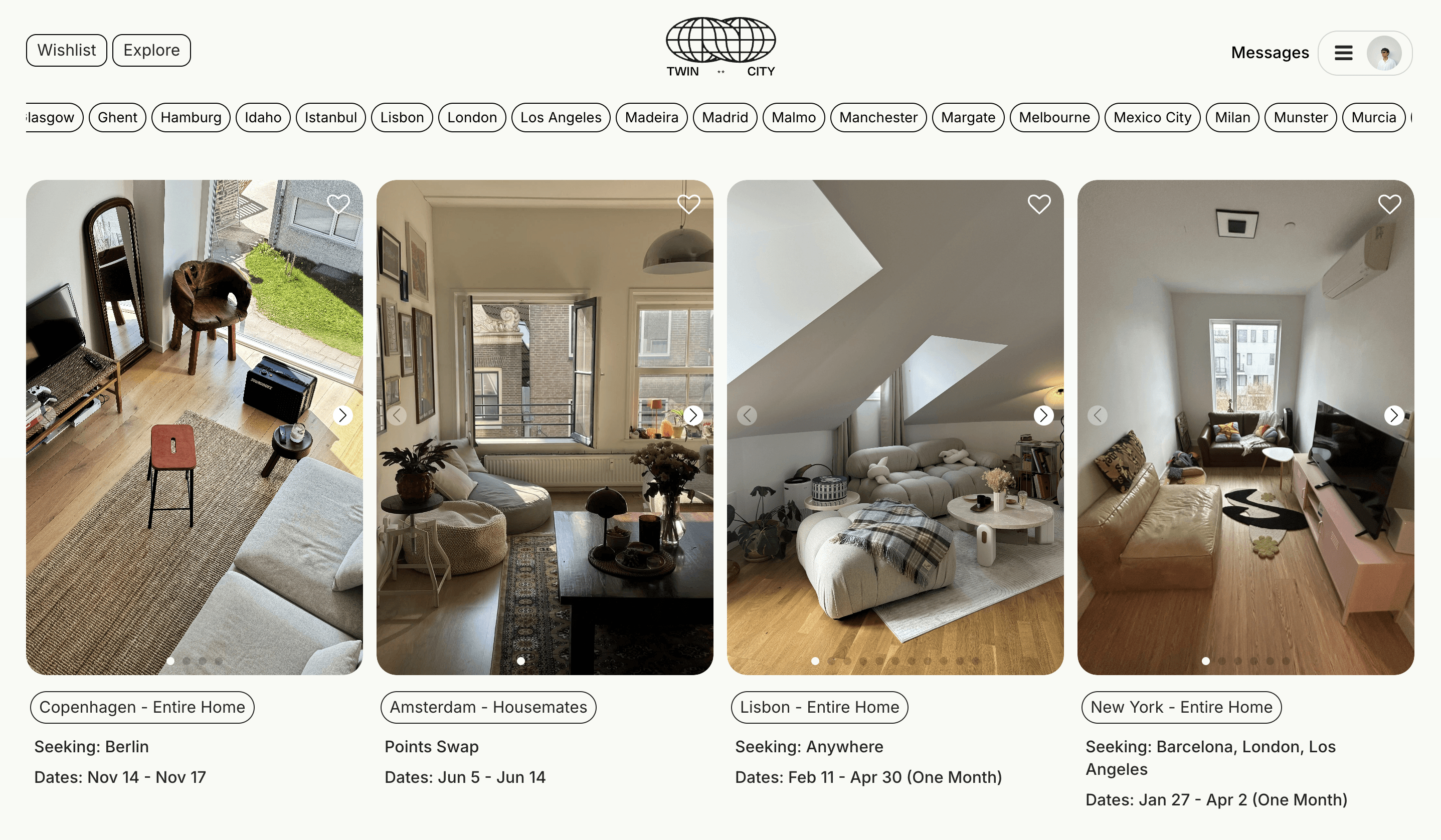
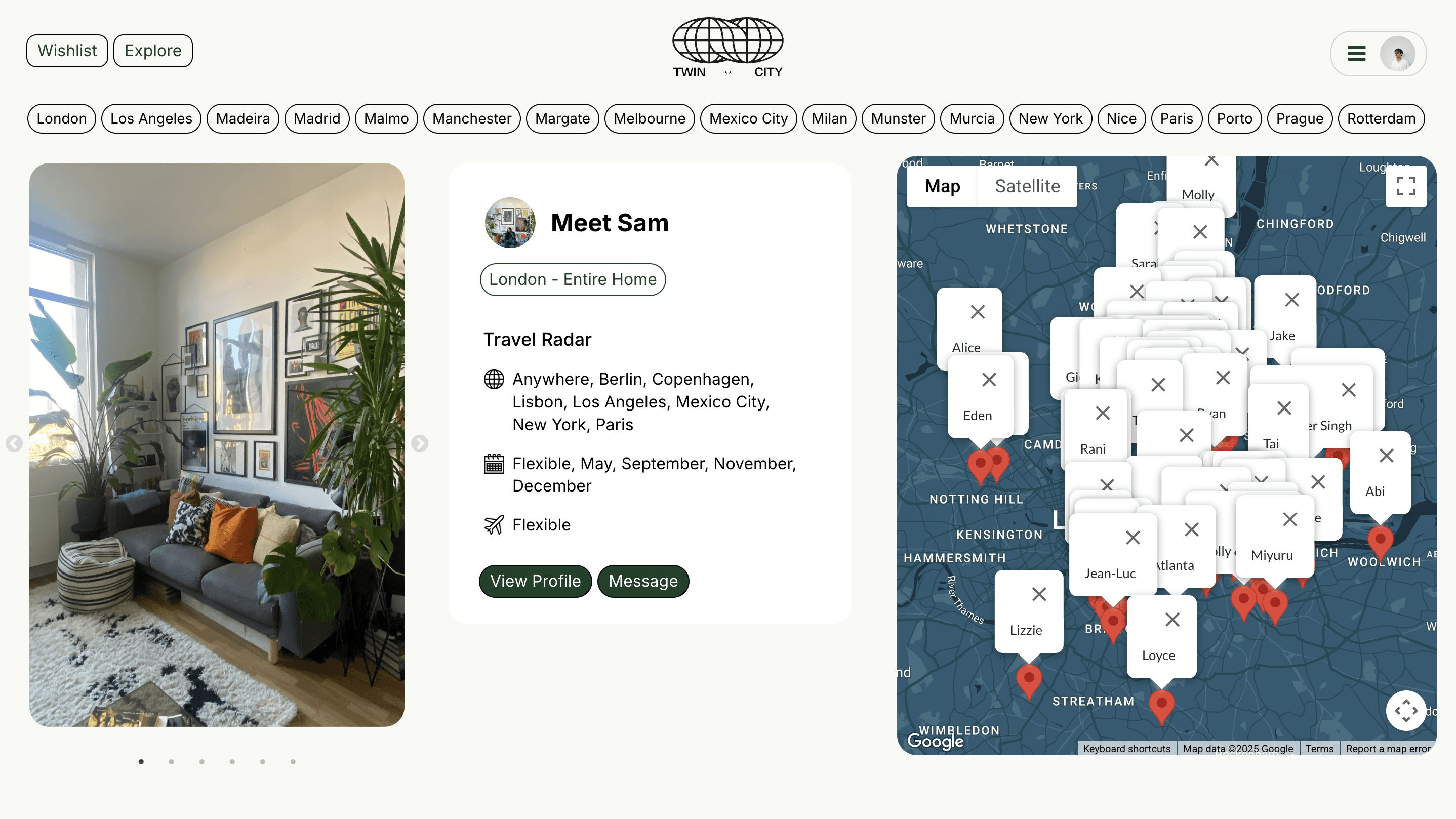
Users could only search by destination, with no way to tell which hosts were actually open to swapping. This made it hard to know who was worth contacting.
Users could only search by destination, with no way to tell which hosts were actually open to swapping. This made it hard to know who was worth contacting.
Unclear Availability
Unclear Availability
Availability was shown as whole months such as “October,” which rarely aligned with users’ proposed dates and caused them to message unavailable hosts.
Availability was shown as whole months such as “October,” which rarely aligned with users’ proposed dates and caused them to message unavailable hosts.
Unstructured Requests
Unstructured Requests
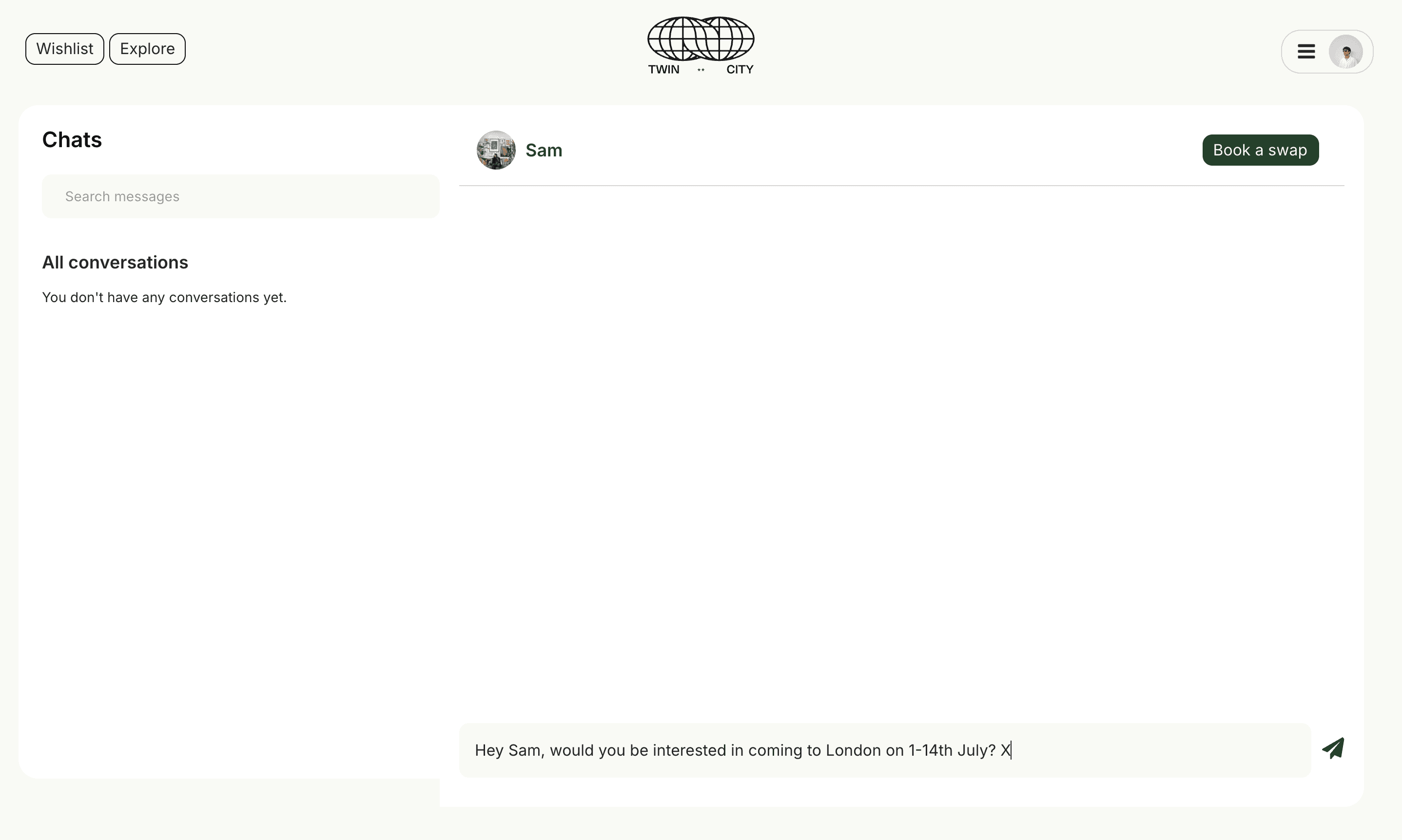
Requests had to be written from scratch and dates weren’t aligned upfront. Conversations quickly slipped into back-and-forth date checking, often losing momentum.
Requests had to be written from scratch and dates weren’t aligned upfront. Conversations quickly slipped into back-and-forth date checking, often losing momentum.
The Solution
Guiding Users to Active, Date-Compatible Members
Guiding Users to Active,
Date-Compatible Members
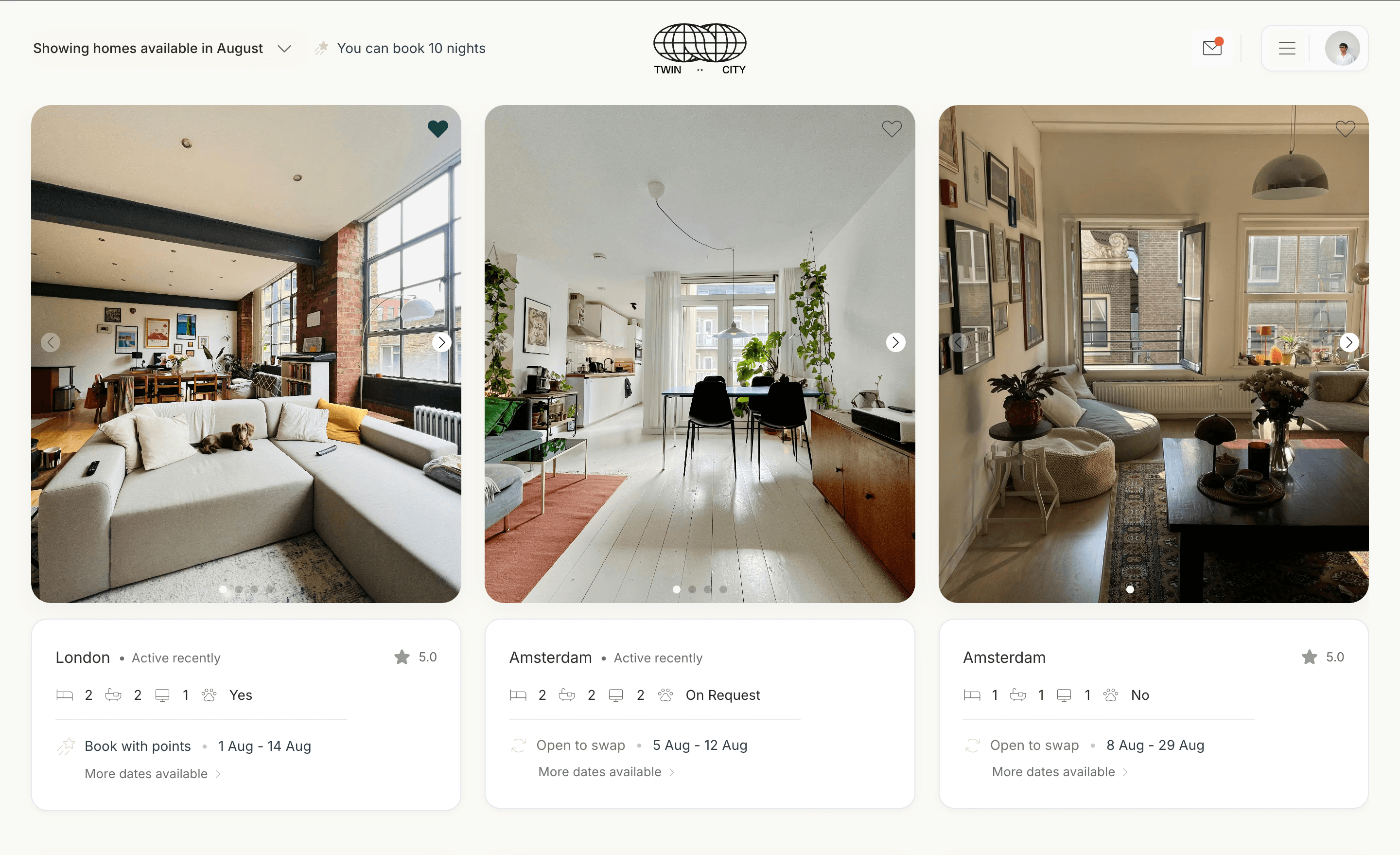
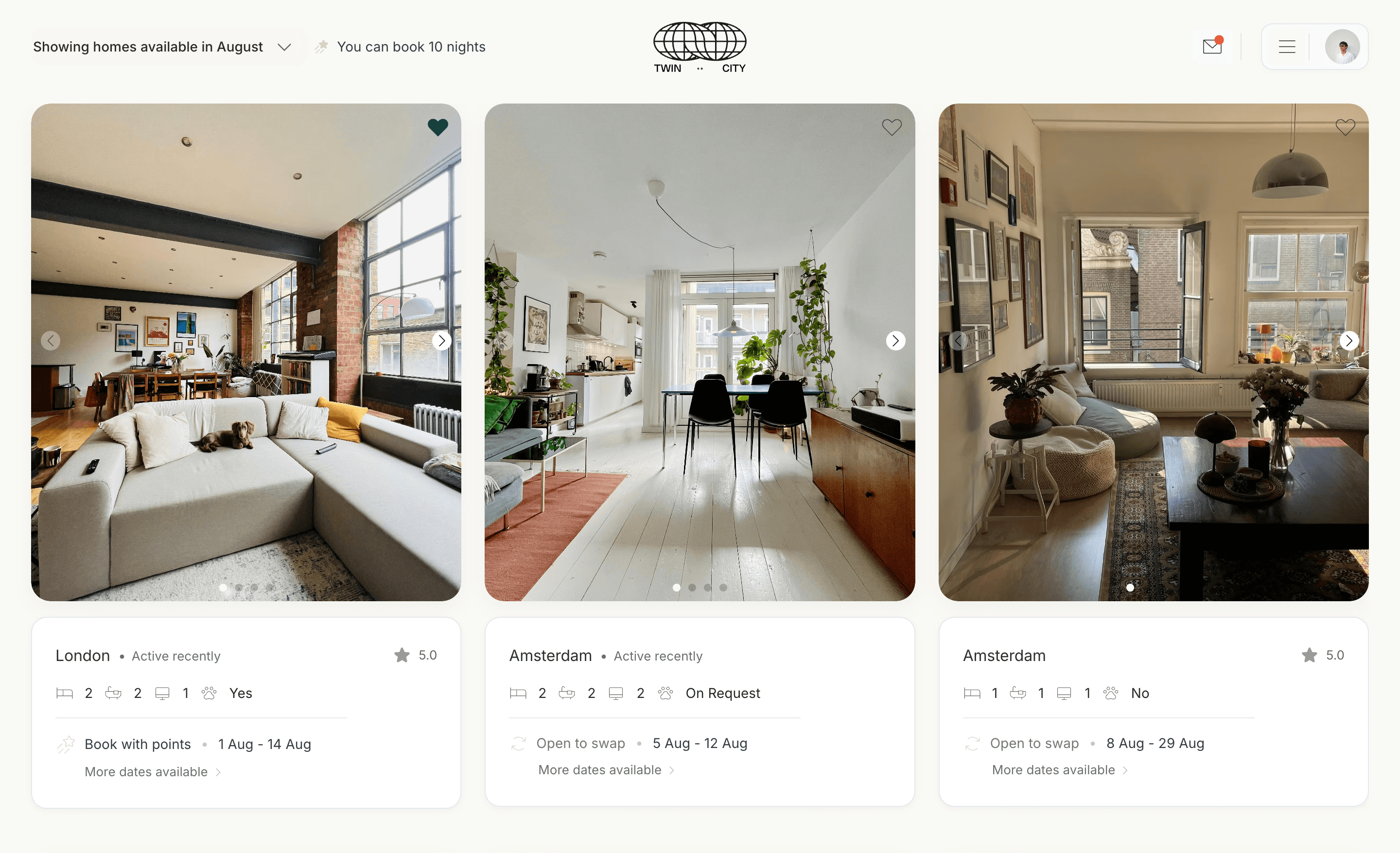
I redesigned the experience around the real driver of successful swaps: overlapping travel dates. Discovery shifted from destination-first to date-first, helping users find viable matches. Clear availability and structured requests now guide users toward compatible, active members, making home swaps reliable to book.
We redesigned the experience around the real driver of successful swaps: overlapping travel dates. Discovery shifted from destination-first to date-first, helping users find viable matches.
Clear availability and structured requests now guide users toward compatible, active members, making home swaps reliable to book.
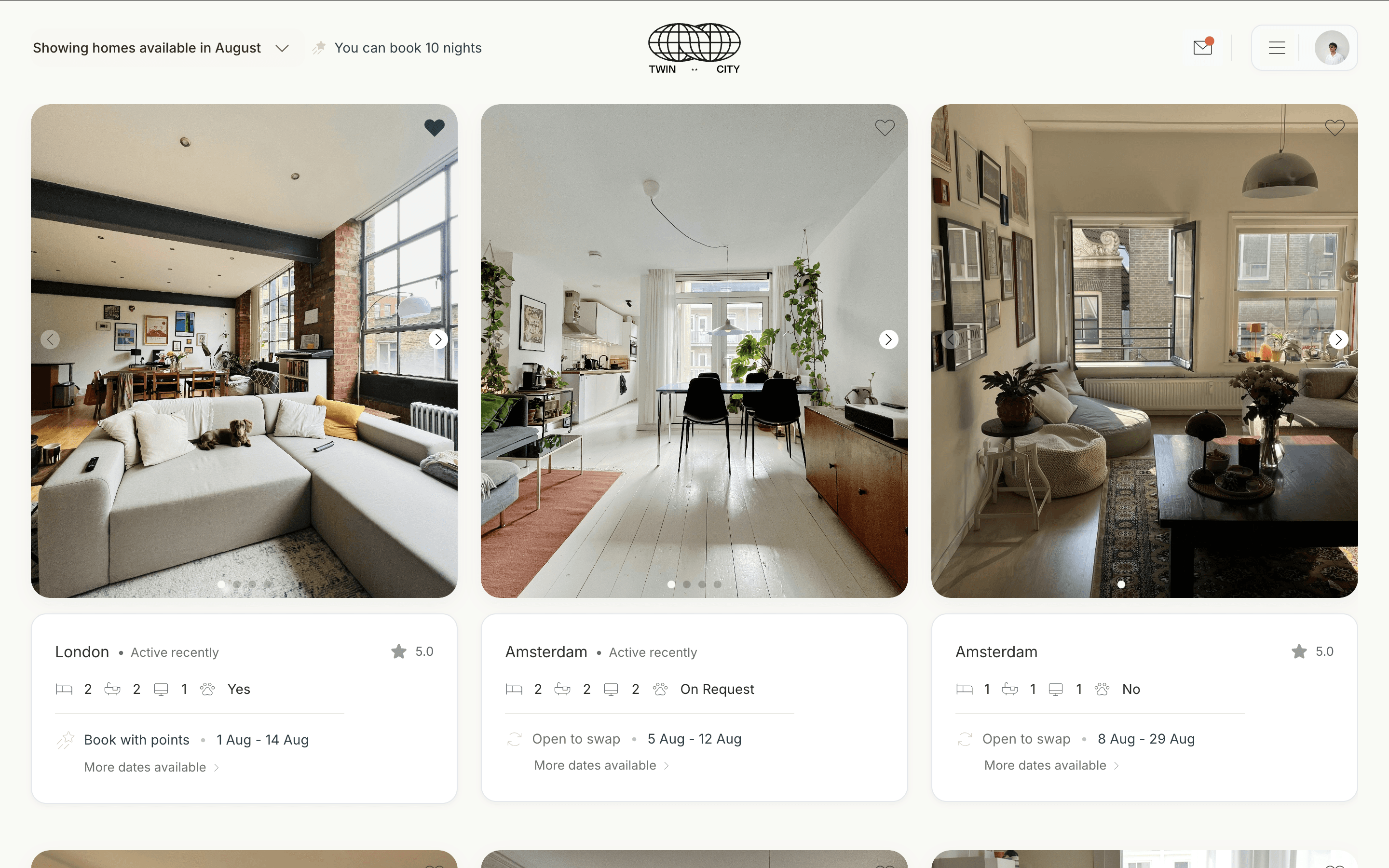
Guided Search
Search now begins with your travel dates, surfacing the active members who are available during that same window.
Search now begins with your travel dates, surfacing the active members who are available during that same window.
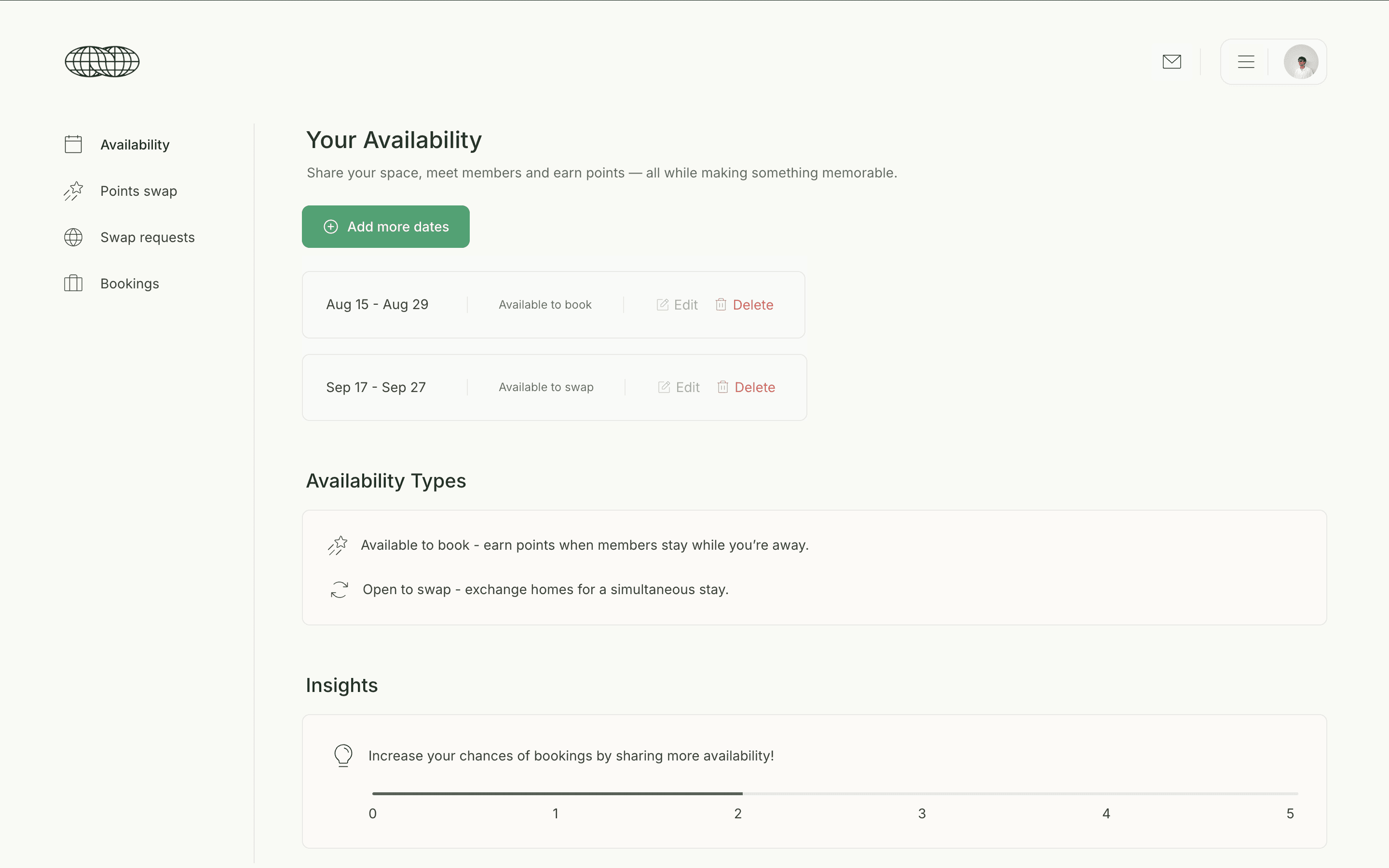
Clear Availability
Hosts can now set specific travel windows instead of vague months, giving others a clear view of their true availability.
Hosts can now set specific travel windows instead of vague months, giving others a clear view of their true availability.
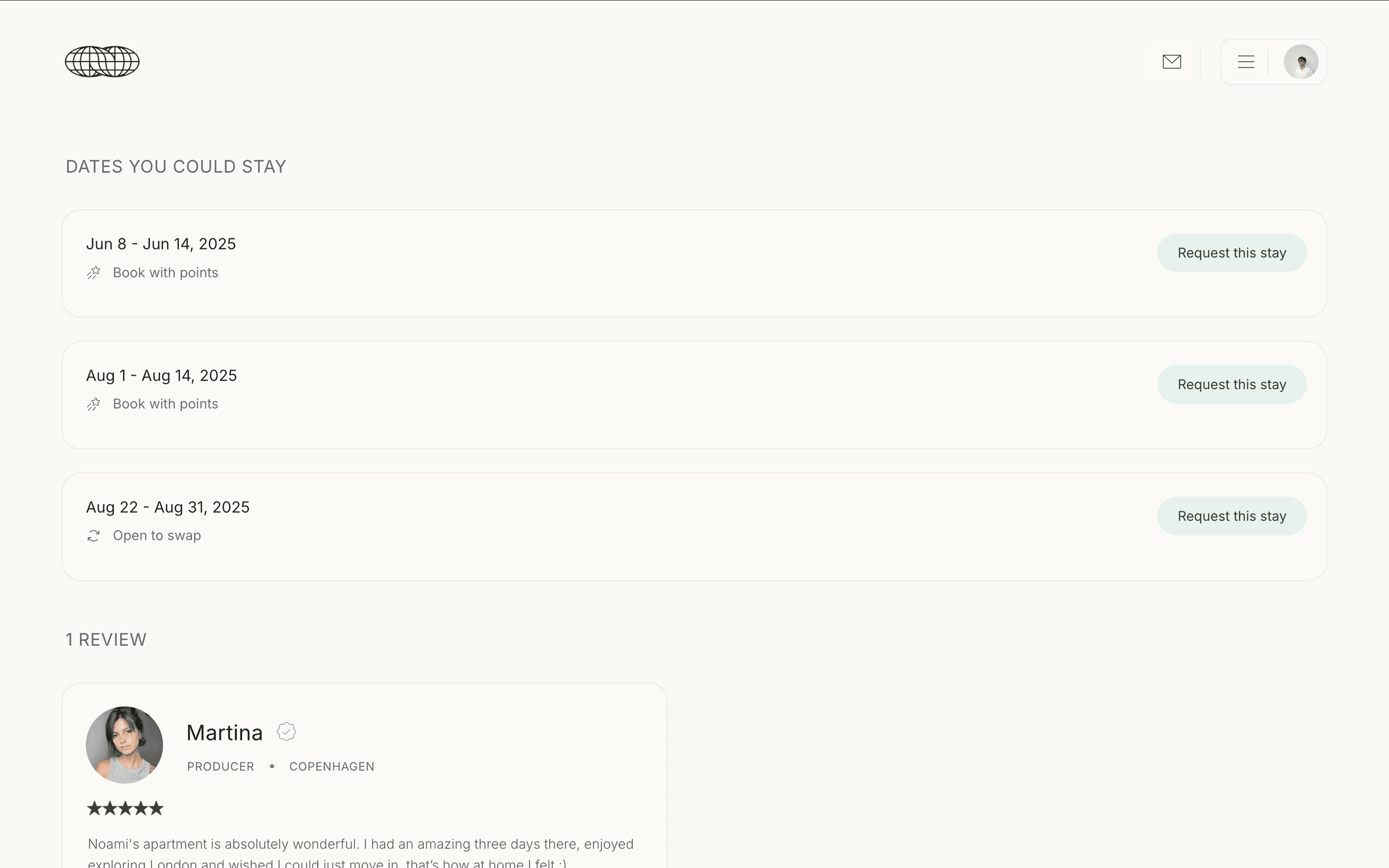
Fast, Structured Requests
People can confidently send aligned, structured swap requests in seconds, ensuring dates match before any communication begins.
People can confidently send aligned, structured swap requests in seconds, ensuring dates match before any communication begins.
The Impact
A Platform That Finally Delivered on Its Promise
A Platform That Finally Delivered on Its Promise
I transformed Twin City from an exciting idea into a reliable, usable platform, helping creatives travel more freely, making Twin City a tool people naturally turn to when planning their next trip.
300%
300%
300%
Swaps Booked
Swaps Booked
Swaps Booked
Weekly swaps increased from 1 to 4.
Weekly swaps increased from 1 to 4.
16
16
16
Monthly Subscriptions
Monthly Subscriptions
Monthly Subscriptions
£9500+ total annual revenue.
£9500+ total annual revenue.
6 → 9
6 → 9
6 → 9
NPS Score
NPS Score
NPS Score
Turning detractors into promoters.
Turning detractors into promoters.
01. Research
01. Research
Why Couldn't Users Complete a Swap?
Why Couldn't Users
Complete a Swap?
With most swap requests failing, I needed to understand why users were not able to complete trips and what actually made a swap succeed. I also wanted to learn about their motivations and how they thought about planning travel. I began with user interviews, leveraging the founders' close relationships with their community.
With most swap requests failing, I needed to understand why users were not able to complete trips and what actually made a swap succeed. I also wanted to learn about their motivations and how they thought about planning travel. I began with user interviews, leveraging the founders' close relationships with their community.
With most swap requests failing, I needed to understand why users were not able to complete trips and what actually made a swap succeed. I also wanted to learn about their motivations and how they thought about planning travel. I began with user interviews, leveraging the founders' close relationships with their community.
X 6
X 6
X 6
User Interviews
User Interviews
Users Were Flexible on Location
Members Were
Flexible on Location

I'm open to most cities.. but my travel windows
are quite fixed because of work
I'm open to most cities..but my travel windows are quite fixed because of work
I'm open to most cities.. but my travel
windows are quite fixed because of work
The connections are nice but
the saving money is the real draw
The connections are nice but
the saving money is the real draw

Aligning Travel Dates Was the Hard Part
Aligning Travel Dates
Was the Hard Part
Across six interviews, a clear challenge emerged. Users were excited to find potential swap partners, but struggled to align travel dates. Back-and-forth messages around availability often stalled conversations before a swap could be agreed.
What Made Matching Dates So Difficult?
What Made Matching
Dates So Difficult?
Old UI - Checking Availability
Old UI - Checking Availability
Confusing Availability
Confusing Availability
Availability was shown broadly as a month, while users proposed specific date ranges. These rarely aligned, often leading to mismatched responses.
Availability was shown broadly as a month, while users proposed specific date ranges. These rarely aligned, often leading to mismatched responses.
Cumbersome Requests
Cumbersome Requests
Requests had to be written from scratch, including proposing dates manually. With no structure to guide the conversation, users felt the system wasn’t helping them move things forward.
Requests had to be written from scratch, including proposing dates manually. With no structure to guide the conversation, users felt the system wasn’t helping them move things forward.
Old UI - Sending Requests
Old UI - Sending Requests
X 3
Expert Interviews
Expert Interviews
The Core Matching Insight
Reviewing the interviews with marketplace experts revealed a key issue. By only filtering on location, the MVP forced users to manually align dates, effectively matching on both location and availability. In a small marketplace, this made successful matches unlikely. Their advice became a turning point:
Reviewing the interviews with marketplace experts revealed a key issue. By only filtering on location, the MVP forced users to manually align dates, effectively matching on both location and availability. In a small marketplace, this made successful matches unlikely. Their advice became a turning point:
"Focus on dates. When we started people
were just available or unavailable"
"Focus on dates.
When we started people
were just available or unavailable"
"Focus on dates. When we started people
were just available or unavailable"
CT0, Carers Marketplace
CT0, Carers Marketplace
The missing piece was knowing who was actually free at the same time. By centering the experience on travel dates and active swappers, we could open up a world of opportunities for users already flexible on where they stay.
The missing piece was knowing who was actually free at the same time. By centering the experience on travel dates and active swappers, we could open up a world of opportunities for users already flexible on where they stay.
02. Define
02. Define
Research Synthesis
Turning Insights into Design Opportunities
Turning Insights into
Design Opportunities
HMW Statements
HMW Statements
How might we guide users toward compatible members instead of leaving them to guess?
How might we guide users toward compatible members instead of leaving them to guess?
How might we help people express and understand availability clearly and accurately?
How might we help people express and understand availability clearly and accurately?
How might we make swap requests fast, structured and confidence-building?
How might we make swap requests fast, structured and confidence-building?
Meet Our Home Swapper
Before moving into ideation, I wanted to distil my understanding of users into a clear persona. This helped ground decisions in real user behaviour and ensured the redesign stayed aligned with what people actually needed. Meet Phoebe, our primary persona. She reflects the flexible traveller we designed for, open to where she goes, but fixed on when she travels.
Before moving into ideation, I wanted to distilled my understanding of users into a clear persona. This helped ground decisions in real user behaviour and ensured the redesign stayed aligned with what people actually needed.
Meet Phoebe, our primary persona. She reflects the flexible traveller we designed for, open to where she goes, but fixed on when she travel.
Before moving into ideation, I wanted to distil my understanding of users into a clear persona. This helped ground decisions in real user behaviour and ensured the redesign stayed aligned with what people actually needed. Meet Phoebe, our primary persona. She reflects the flexible traveller we designed for, open to where she goes, but fixed on when she travels.
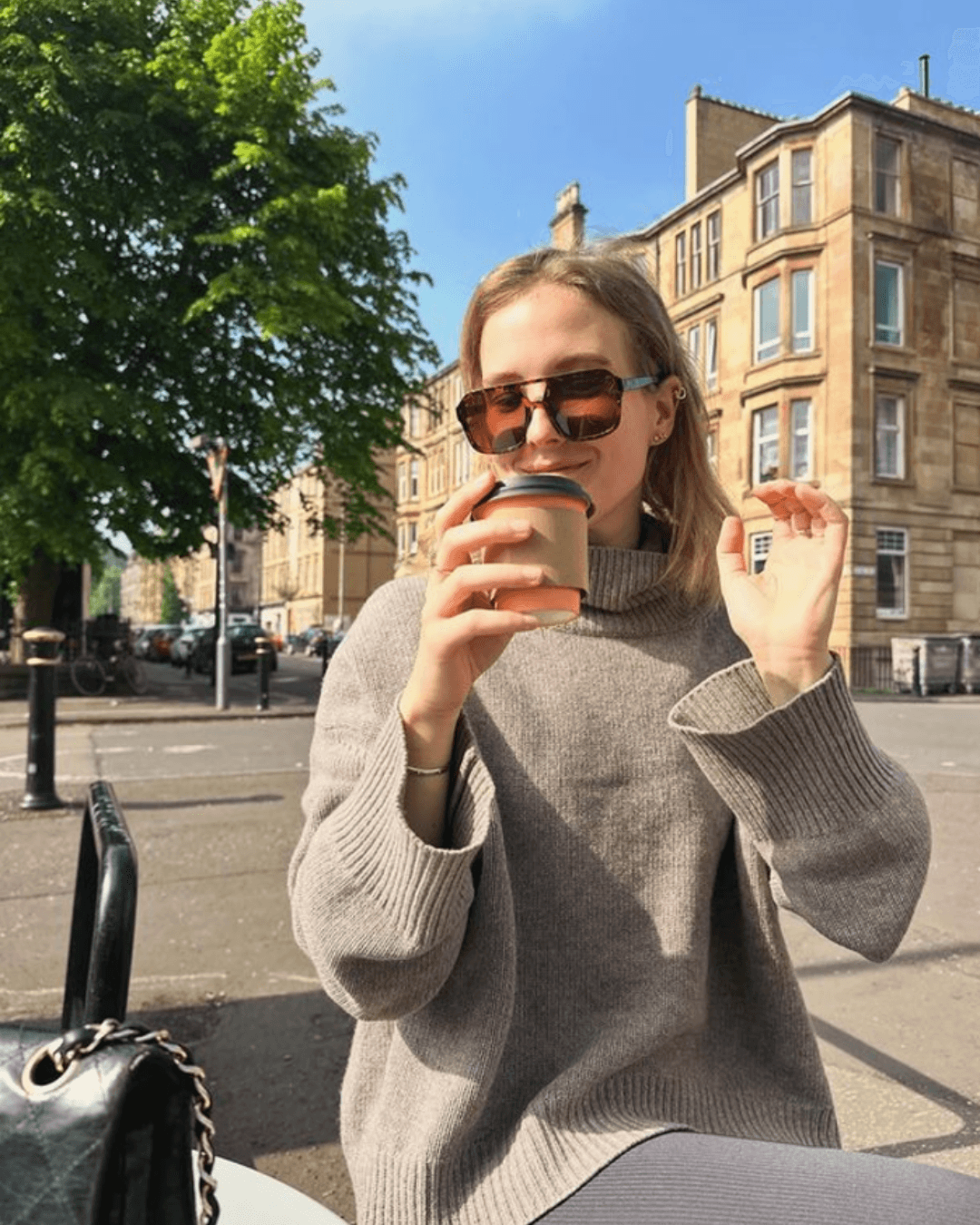
Phoebe
32, London
Brand Strategist
Bio
Bio
Phoebe is a freelance brand strategist who works with the likes of Nike & Spotify. She and her partner own a two‑bedroom home in Hackney, London.
Phoebe is a freelance brand strategist who works with the likes of Nike & Spotify. She and her partner own a two‑bedroom home in Hackney, London.
Personality
Personality
• Creative
• Creative
• Open-minded
• Open-minded
• Consciousness
• Consciousness
• Spontaneous
• Spontaneous
Goals
Goals
• Travel affordably by eliminating accommodation costs
• Find great swaps for her available dates, wherever they might be
• Stay in well-designed homes in authentic neighborhoods
• Travel affordably by eliminating accommodation costs
• Find great swaps for her available dates, wherever they might be
• Stay in well-designed homes in authentic neighborhoods
Furstrations
Furstrations
• Can’t find matches, so struggles to use Twin City for trips
• Wastes time messaging people who aren’t available
• Can’t find matches, so struggles to use Twin City for trips
• Wastes time messaging people who aren’t available
“I love living like a local and feeling connected to a city’s culture”
“I love living like a local and feeling connected to a city’s culture”
Empathising with Phoebe's Journey
The platform was failing Phoebe. When she was planning a trip, she needed to find a swap partner, fast. Mapping her journey helped visualise where momentum was lost and started revealing where the platform could guide her more effectively.
The platform was failing Phoebe. When she was planning a trip, she needed to find a swap partner, fast. Mapping her journey helped visualise where momentum was lost and started revealing where the platform could guide her more effectively.
Phoebe
GOALS
Find like-minded people she can swap homes with in April
Understand which destinations are available for her dates
STAGE
STAGE
Planning a Trip
Planning a Trip
Finding Homes
Finding Homes
Understanding Compatibility
Understanding
Compatibility
Sending a Request
Sending a Request
Giving Up
Giving Up
ACTION
ACTION
Opens Twin City
Opens Twin City
Browses by location
Browses by location
Scans profiles
Scans profiles
Composes a
manual message
Composes a
manual message
Messages back & forth
Messages back & forth
MINDSET
MINDSET
😁
“I love the idea "
“I love the idea "
“This feels new…
Where do I start?
“This feels new…
Where do I start?
🤔
“I can't search by
my dates?”
“I can't search by
my dates?”
“London would
be nice but I'm open
to anywhere in Europe”
“London would
be nice but
I'm open
to anywhere
in Europe”
🧐
“This availability is
a little vague"
“This availability is
a little vague"
“Will they be actually
free on my dates??”
“Will they be actually
free on my dates??”
😅
"This feels awkward”
"This feels awkward”
"I'm not sure
this will
go anywhere?”
"I'm not sure
this will
go anywhere?”
😔
“I can't agree
on dates
with anyone”
“I can't agree
on dates
with anyone”
“Maybe the
platform just
doesn't work”
“Maybe the
platform just
doesn't work”
OPP
OPP
Create a familiar,
intuitive homepage
that guides users into the journey
Create a familiar,
intuitive homepage
that guides users
into the journey
Introduce effective
date filtering
Guide users to members most
likely to swap
with them
Introduce effective
date filtering
Guide users to
members most
likely to swap
with them
Provide a precise,
visual travel calendar
that makes
compatibility clear
Provide a precise,
visual travel calendar
that makes
compatibility clear
Streamline requests with a structured flow that feels intentional
Automate dates proposal
Streamline requests with a structured flow that feels intentional
Automate dates proposal
Encourage momentum with response rate indicators
Gamify rewards
for engaged community members
Encourage momentum with response
rate indicators
Gamify rewards
for engaged community members
03. Ideate
03. Ideate
This section focuses specifically on improving how users send requests.
This section focuses specifically on improving how users send requests.
How might we make swap requests fast, structured and confidence-building?
How might we make swap requests fast, structured and confidence-building?
How might we make swap requests fast,
structured and confidence-building?
Three Explorations
After Crazy 8s, I explored three different ways to simplify how users send requests. A pop-up flow felt right for speed, but the bigger challenge was reducing the back-and-forth required to align dates and giving people a clearer way to move conversations forward. I prototyped each concept directly in Bubble (the live app) to understand technical constraints early and tested them quickly with users before landing on the final direction.
After Crazy 8s, I explored three different ways to simplify how users send requests. A pop-up flow felt right for speed, but the bigger challenge was reducing the back-and-forth required to align dates and giving people a clearer way to move conversations forward.
I prototyped each concept directly in Bubble (the live app) to understand technical constraints early and tested them quickly with users before landing on the final direction.
After Crazy 8s, I explored three different ways to simplify how users send requests. A pop-up flow felt right for speed, but the bigger challenge was reducing the back-and-forth required to align dates and giving people a clearer way to move conversations forward. I prototyped each concept directly in Bubble (the live app) to understand technical constraints early and tested them quickly with users before landing on the final direction.
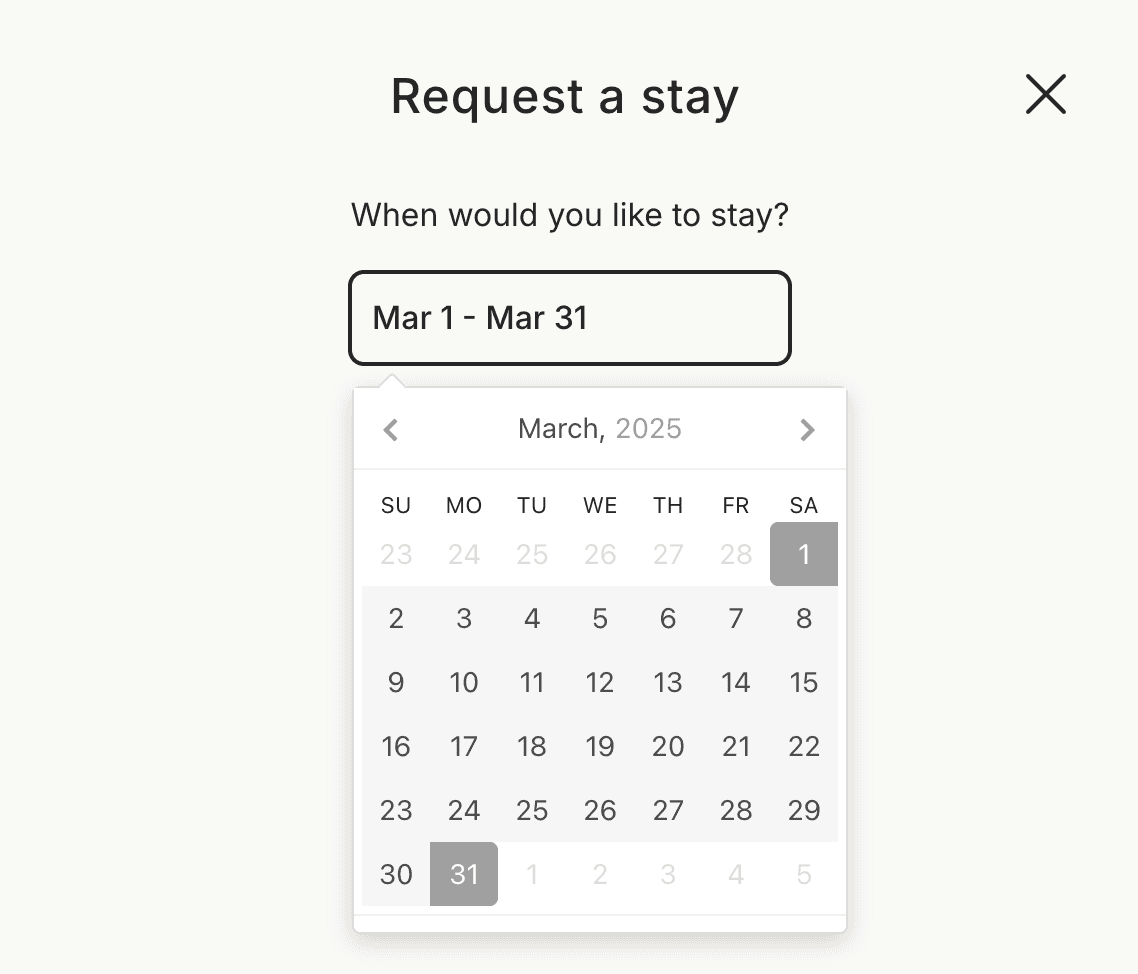
Exploration 1: Super Quick Request
Exploration 1: Super Quick Request
Exploration 1: Super Quick Request
Users send a request by simply picking dates.
No message required.
Users send a request by simply picking dates.
No message required.
Conclusion
Conclusion
Conclusion
Too little context - requests without a short, thoughtful message left hosts without context, reducing trust and willingness to respond. Home swapping felt too personal to engage with otherwise.
Too little context - requests without a short, thoughtful message left hosts without context, reducing trust and willingness to respond. Home swapping felt too personal to engage with otherwise.
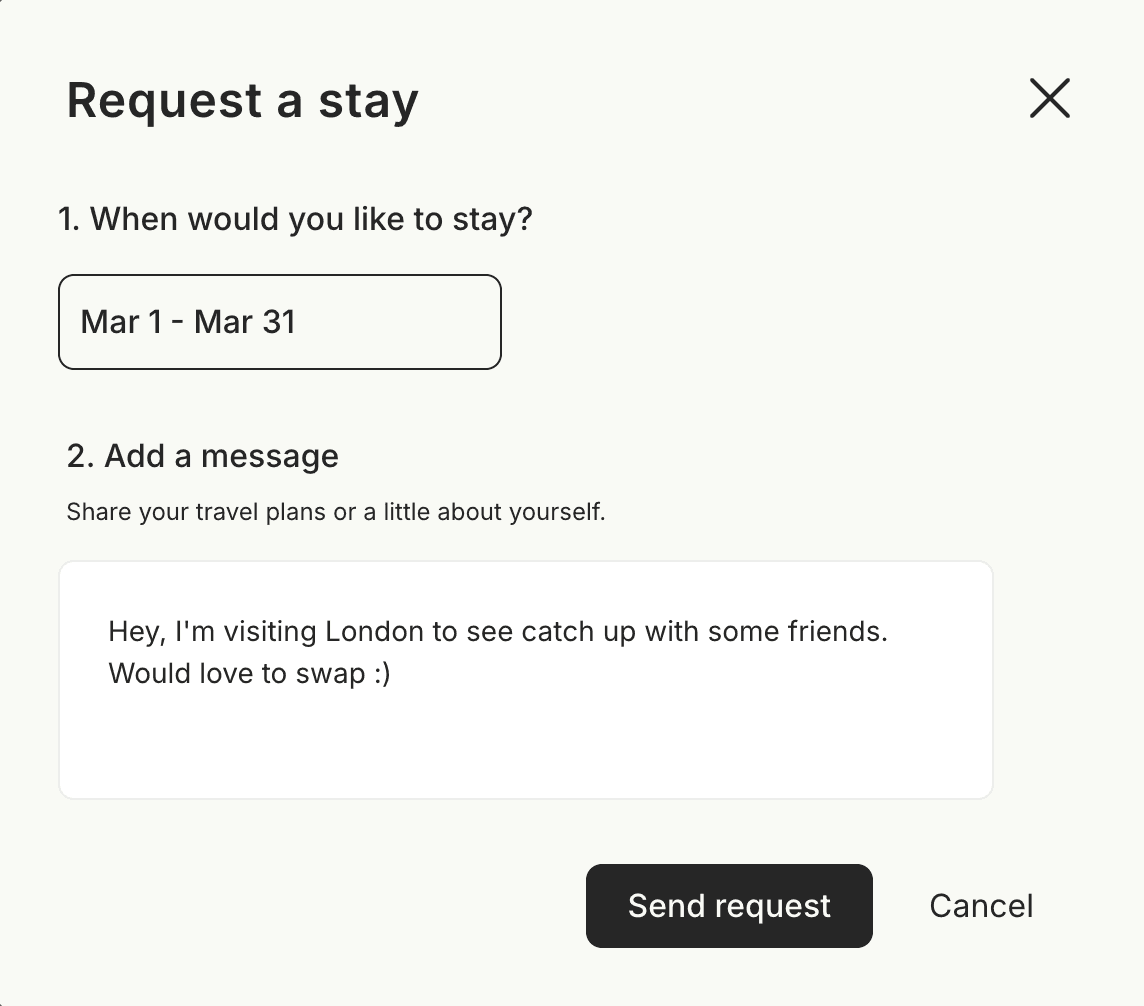
Exploration 2: Dates + Message
Exploration 2: Dates + Message
Exploration 2: Dates + Message
A balanced approach: users choose dates and add a message.
A balanced approach: users choose dates and add a message.
Conclusion
Conclusion
Conclusion
Date misalignment still persisted - people naturally picked the dates they wanted, not the ones hosts had set, so the core date matching issue stayed unsolved.
Date misalignment still persisted - people naturally picked the dates they wanted, not the ones hosts had set, so the core date matching issue stayed unsolved.
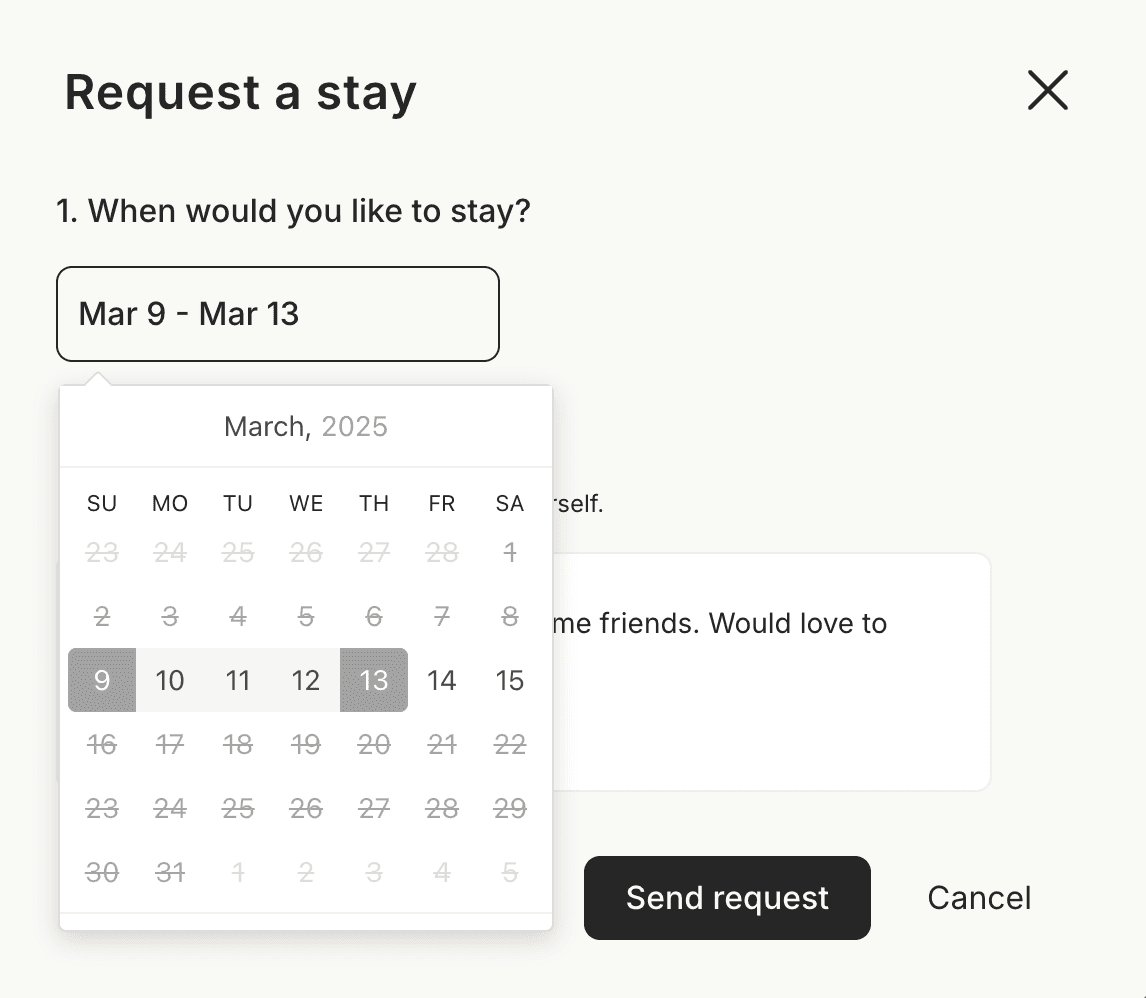
Exploration 3: Availability Guided Request
Exploration 3: Availability Guided Request
Exploration 3: Availability Guided Request
Users propose dates directly from the host’s actual availability, with the option to add a personal note.
Users propose dates directly from the host’s actual availability, with the option to add a personal note.
Conclusion
Conclusion
Conclusion
Aligned dates - users can only choose from the host’s actual travel calendar.
Confidence - selecting valid dates made the request feel intentional and worth sending.
Meaningful replies - hosts were more engaged because proposals aligned with their plans.
Aligned dates - users can only choose from the host’s actual travel calendar.
Confidence - selecting valid dates made the request feel intentional and worth sending.
Meaningful replies - hosts were more engaged because proposals aligned with their plans.
04. Usability Testing
04. Usability Testing
Did the Redesign Work?
Would the Redesign Actually
Did the Redesign Work?
By this point we had reworked the core user flow and introduced lots of changes to the platform. We needed to validate quickly and ensure the new experience made swapping easier. I ran six remote usability sessions with people from our target audience, using short task-based prompts like 'Find all homes available between 1-7 June'.
By this point we had reworked the core user flow and introduced lots of changes to the platform. We needed to validate quickly and ensure the new experience swapping easier.
I ran six remote usability sessions with people from our target audience, using short task-based prompts like 'Find all homes available between 1-7 June'.
Testing Objectives
Testing Objectives
Can users discover homes available on their dates?
Can they set and clearly understand availability?
How quickly and confidently can they send a swap request?
Do they get confused or stuck at any point?
Can users discover homes available on their dates?
Can they set and clearly understand availability?
How quickly and confidently can they send a swap request?
Do they get confused or stuck at any point?
Can users discover homes available on their dates?
Can they set and clearly understand availability?
How quickly and confidently can they send a swap request?
Do they get confused or stuck at any point?
X 6
X 6
Usability Tests
Usability Tests
Key Findings
The redesign landed well. People told us the new experience felt 'so much clearer' and they were excited to use it. However, testing surfaced a few issues that were still holding the flow back from being fully intuitive.
The redesign landed well. People told us the new experience felt 'so much clearer' and they were excited to use it. However, testing surfaced a few issues that were still holding the flow back from being fully intuitive.
Positive Feedback
Positive Feedback
Positive Feedback
Setting availability felt clear and accurate for all users
Every tester sent a request in under five seconds and felt confident about it
Searching by dates felt intuitive and reassuring
Negative Feedback
Negative Feedback
Negative Feedback
Five testers found the listings dense and said the wording didn’t match their mental model
Adding dates in the search bar confused four of six testers
Exact-date searches returning few results reduced trust for three testers
Resulting Revisions
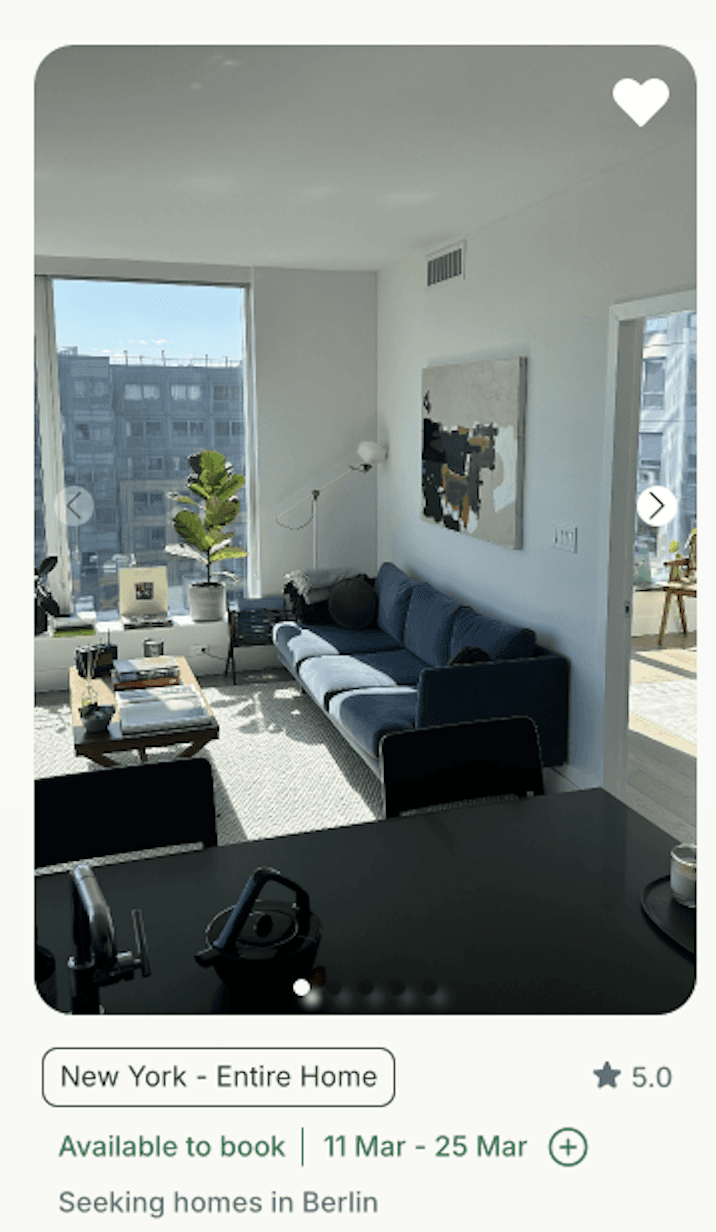
Before
After
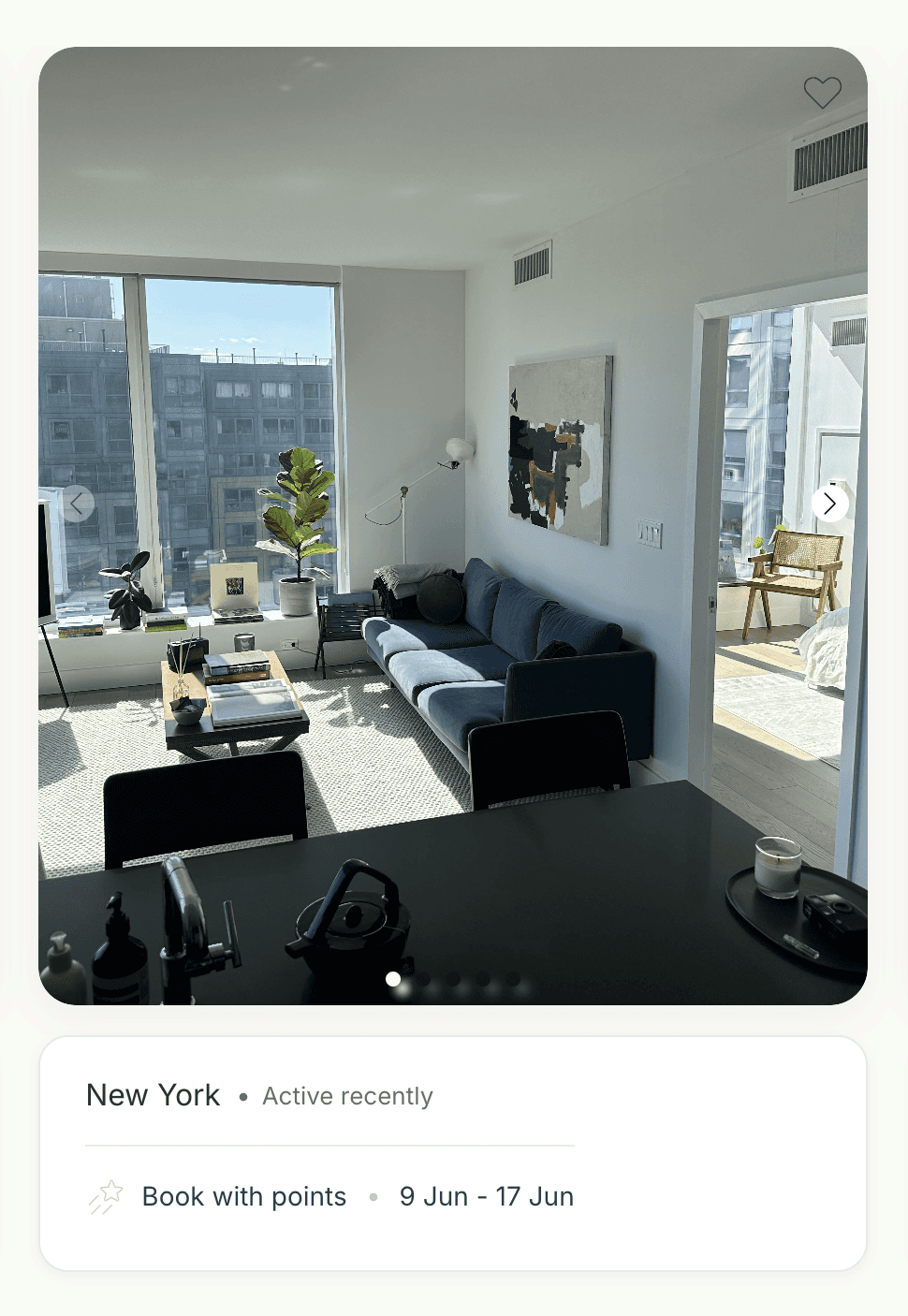
Refined listing cards show key details at a glance, written in language that matches how they think and scan.
Refined listing cards show key details at a glance, written in language that matches how they think and scan.
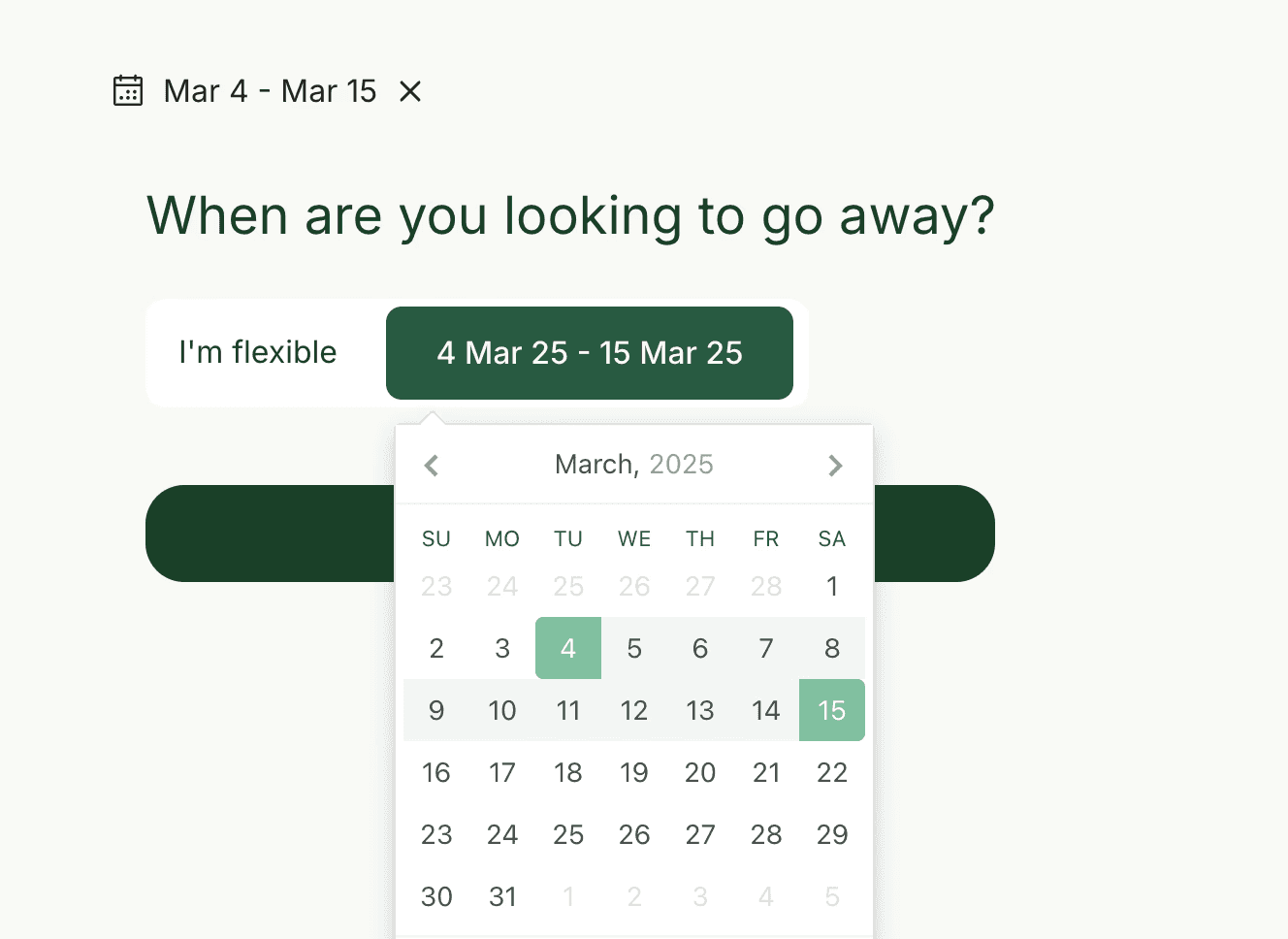
Before
After
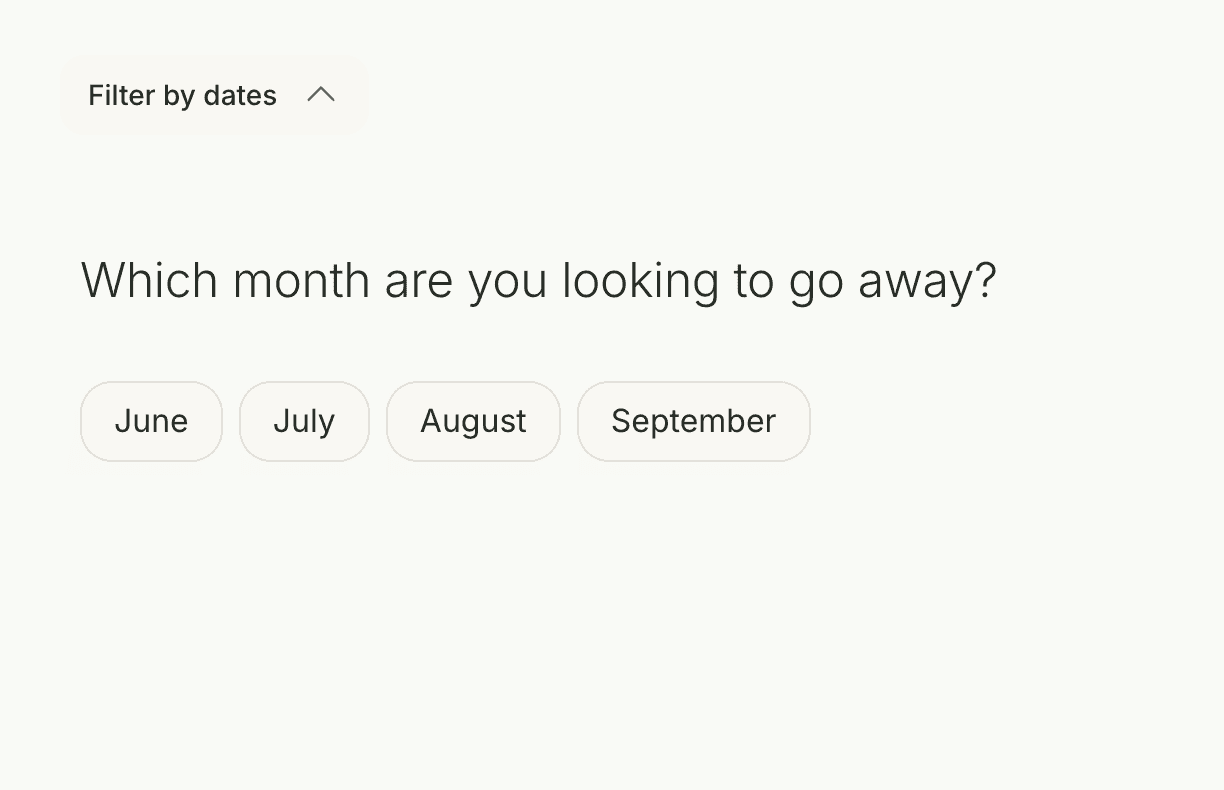
Simplified date filters reduced confusion and removed dead ends for launch, helping users discover viable options.
Simplified date filters reduced confusion and removed dead ends for launch, helping users discover viable options.
05. Final Designs
05. Final Designs
05. Final Designs
Add Availability
Members set precise date windows to clearly communicate when they’re open to swap.
Search by Dates
Results surface only active members with overlapping availability.
Visit Profile
Profiles combine personality and reviews to help users build trust before reaching out.
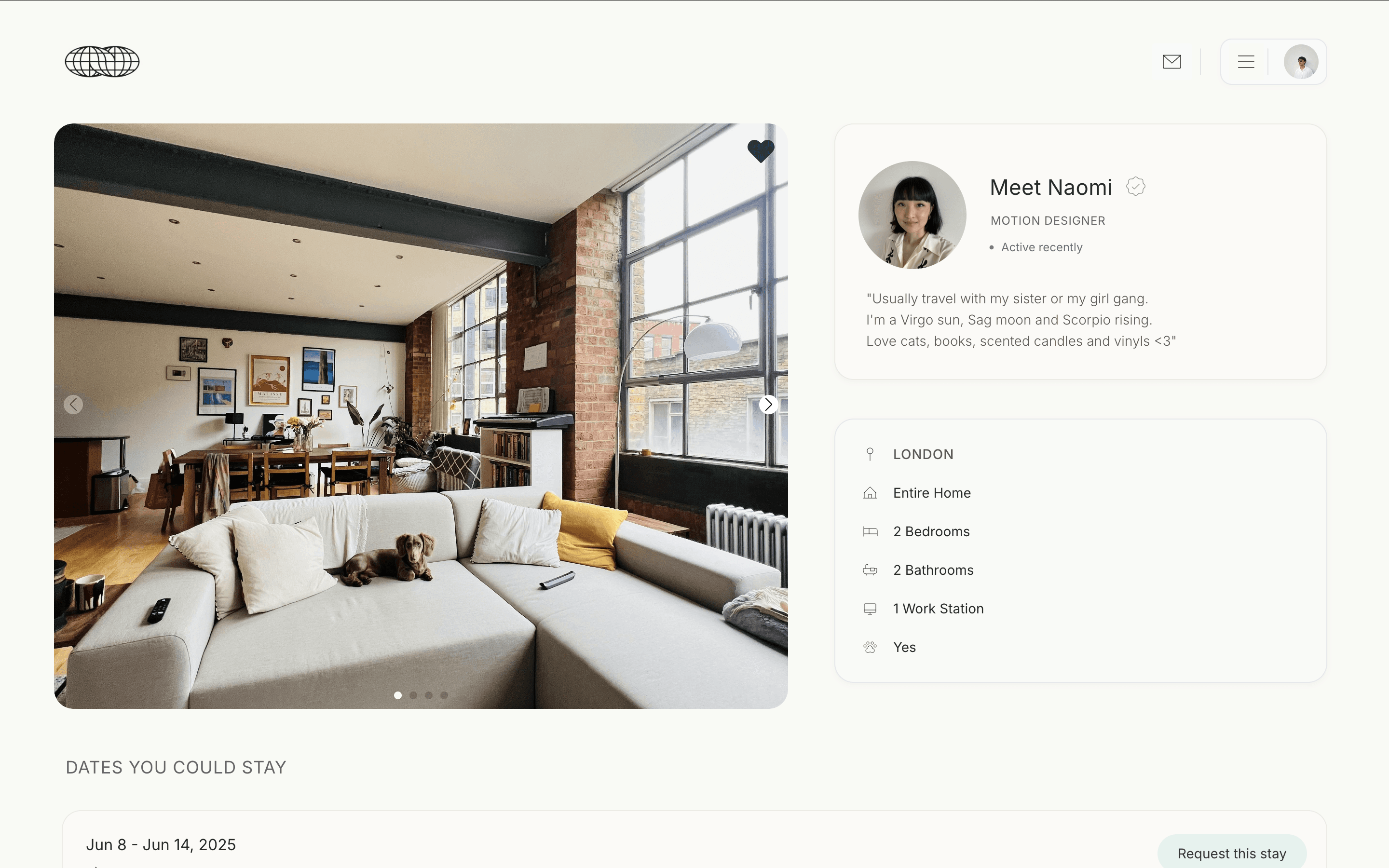
Date Availability Display
Availability stays visible throughout the experience, giving users clarity and confidence.
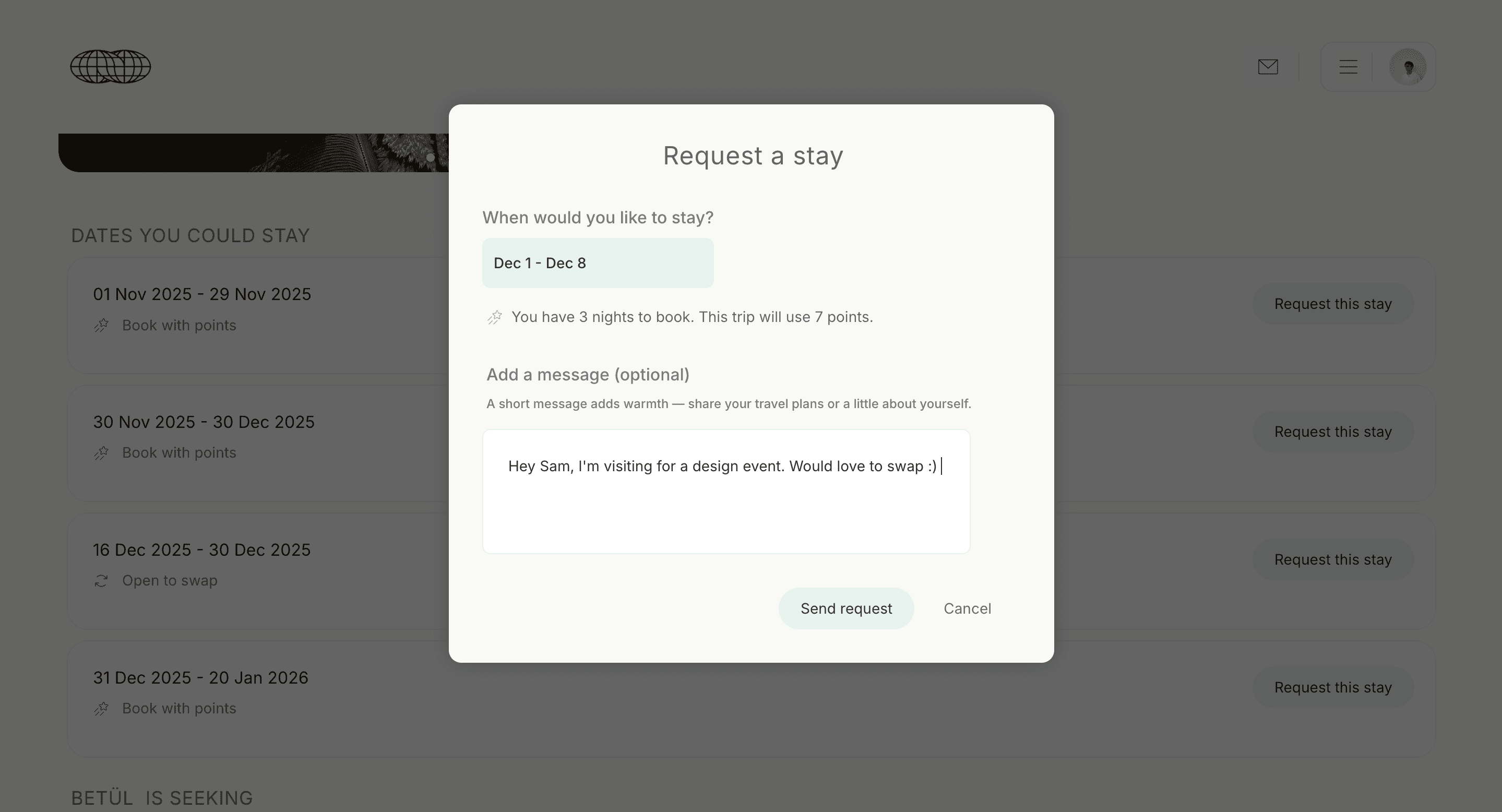
Request Dates
Requests are guided by confirmed availability, keeping outreach quick and low effort.
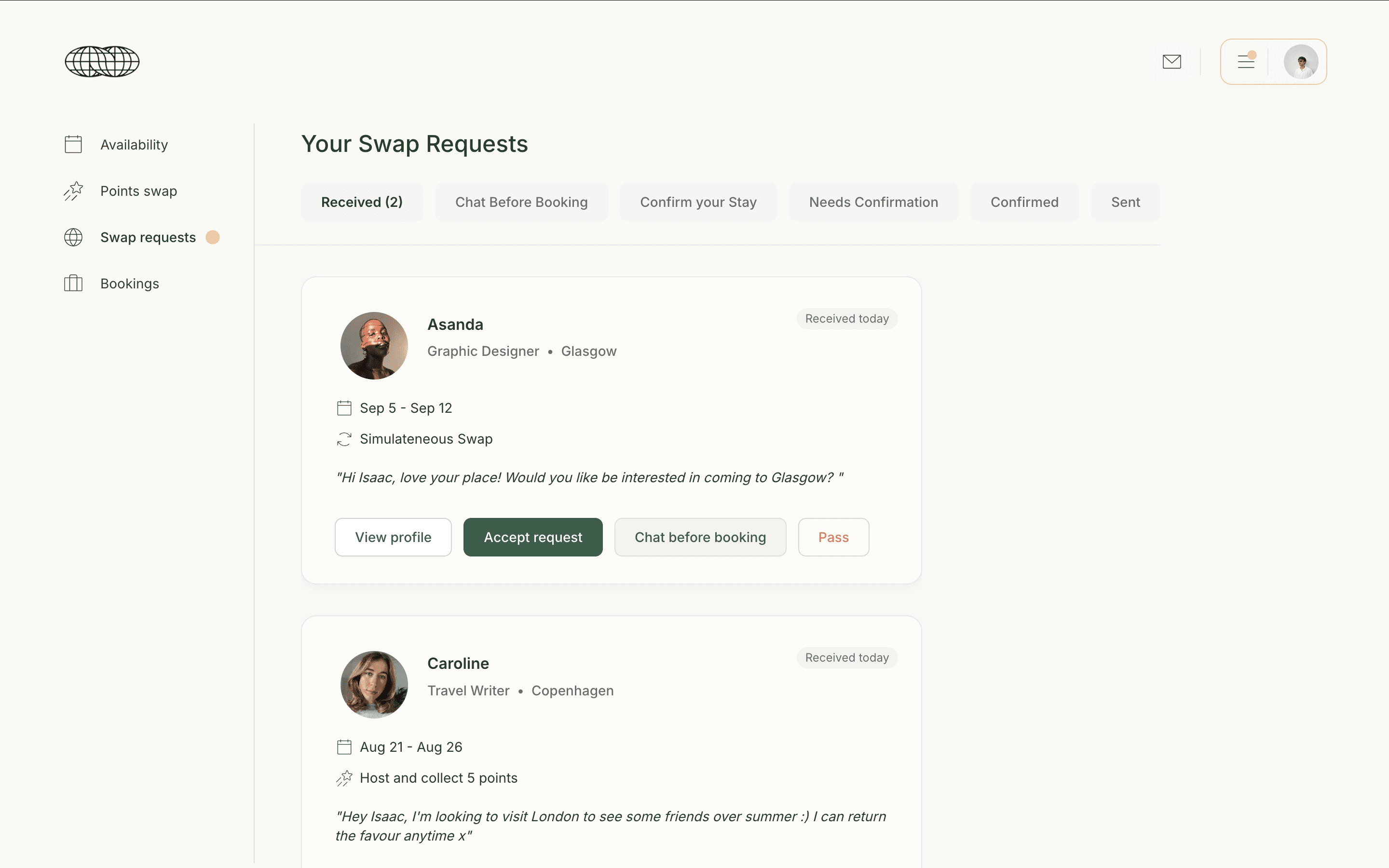
Manage Requests Dashboard
Hosts only manage requests from compatible members, reducing noise and decision fatigue.
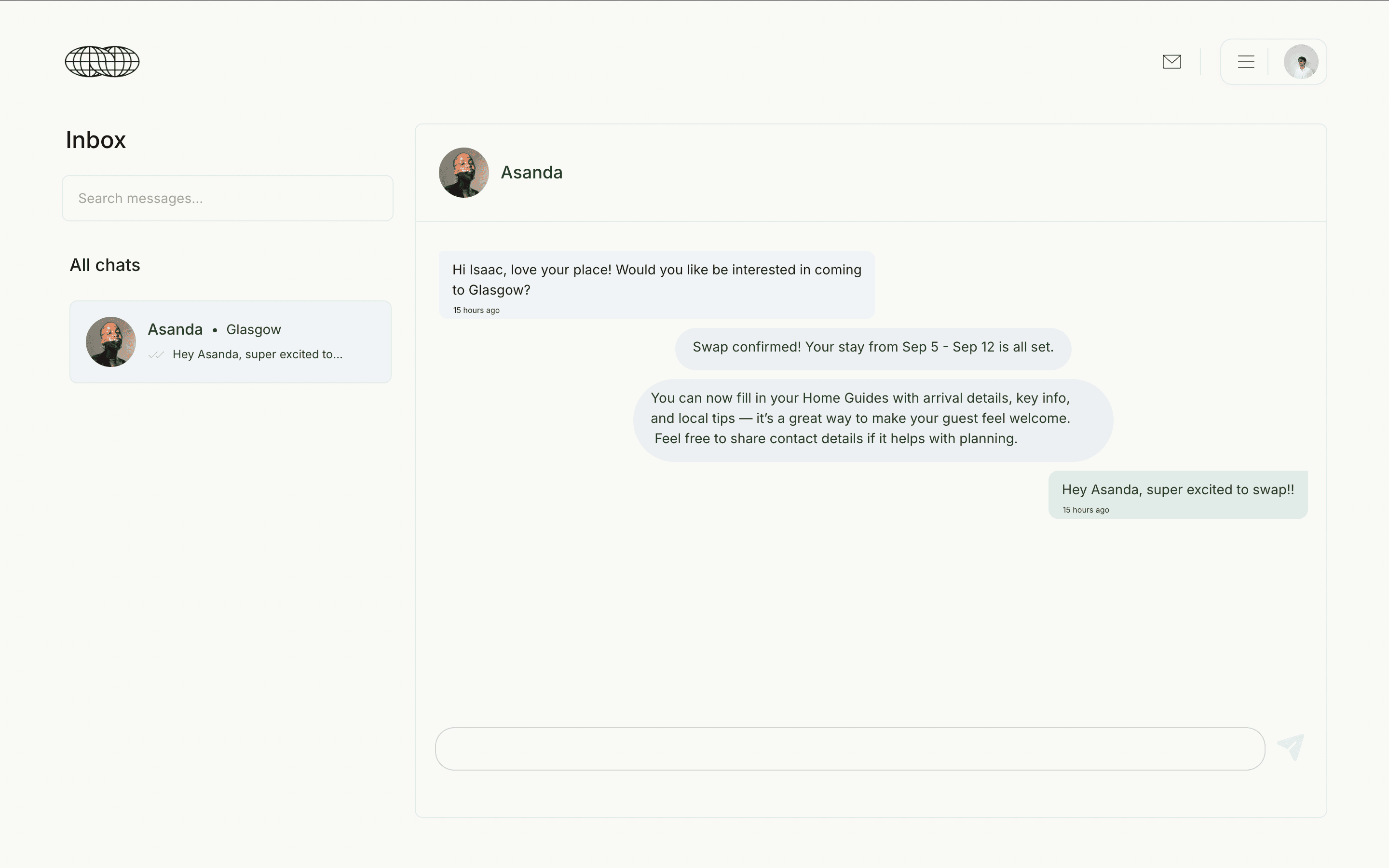
Chat
Conversations start with shared intent, supported by a structured request flow.
Add Availability
Members set precise date windows to clearly communicate when they’re open to swap.
Search by Dates
Results surface only active members with overlapping availability.
Visit Profile
Profiles combine personality and reviews to help users build trust before reaching out.
Date Availability Display
Availability stays visible throughout the experience, giving users clarity and confidence.
Request Dates
Requests are guided by confirmed availability, keeping outreach quick and low effort.
Manage Requests
Hosts only manage requests from compatible members, reducing noise and decision fatigue.
Chat
Conversations start with shared intent, supported by a structured request flow.
Add Availability
Members set precise date windows to clearly communicate when they’re open to swap.
Search by Dates
Results surface only active members with overlapping availability.
Visit Profile
Profiles combine personality and reviews to help users build trust before reaching out.
Date Availability Display
Availability stays visible throughout the experience, giving users clarity and confidence.
Request Dates
Requests are guided by confirmed availability, keeping outreach quick and low effort.
Manage Requests
Hosts only manage requests from compatible members, reducing noise and decision fatigue.
Chat
Conversations start with shared intent, supported by a structured request flow.
06. Reflections
06. Reflections
06. Reflections
What I’d Do Differently
Prototype Faster
Prototype Faster
I learned that the most value comes from getting products in users’ hands quickly. I spent too much time creating highly realistic prototypes, which slowed iteration. Next time, I’d prototype rapidly for usability, test many variations and see exactly how users interact with them.
I learned that the most value comes from getting products in users’ hands quickly.
I spent too much time creating highly realistic prototypes, which slowed iteration. Next time, I’d prototype rapidly for usability, test many variations and see exactly how users interact with them.
Shorten the Scope
Shorten the Scope
The MVP needed a workflow redesign across three problem areas at once. While this gave a holistic view, it reduced focus on each area and slowed iteration. I’d tackle one problem at a time to ensure each solution is tested and refined before moving to the next.
The MVP needed a workflow redesign across three problem areas at once. While this gave a holistic view, it reduced focus on each area and slowed iteration. I’d tackle one problem at a time to ensure each solution is tested and refined before moving to the next.
Get More Collaboration
Get More Collaboration
As my first real project, I sometimes felt out of my depth. More mentorship, workshop guidance and collaboration would have helped. I’d advocate for this support early, even within tight budgets.
As my first real project, I sometimes felt out of my depth. More mentorship, workshop guidance and collaboration would have helped. I’d advocate for this support early, even within tight budgets.
Looking Ahead
Focus on Engaging Users
Focus on Engaging Users
While the platform was working well, there was still some user inactivity. I’d explore ways to keep people returning regularly, whether through reminders, highlighting new swaps or small nudges that make the experience feel alive and engaging.
While the platform was working well, there was still some user inactivity. I’d explore ways to keep people returning regularly, whether through reminders, highlighting new swaps or small nudges that make the experience feel alive and engaging.
Build More Recommendation Features
Build More Recommendation Features
Home swapping is deeply personal, so I’d focus on adding curated suggestions that guide users toward matches they’re likely to connect with, making it easier for members to find compatible swap partners without extra effort.
Home swapping is deeply personal, so I’d focus on adding curated suggestions that guide users toward matches they’re likely to connect with, making it easier for members to find compatible swap partners without extra effort.
Make Mobile Friendly
Make Mobile Friendly
Most users were used to the laptop experience, but the platform needed to work seamlessly on smaller screens. I’d design a similar mobile experience to ensure swapping stays clear, intuitive and enjoyable anywhere.
Most users were used to the laptop experience, but the platform needed to work seamlessly on smaller screens. I’d design a similar mobile experience to ensure swapping stays clear, intuitive and enjoyable anywhere.
Twin City
Redesigning a Home Swapping App
to Help Creatives Travel Freely
Role
UX/UI Designer
User Research
No Code Developer
Timeline
March - June 2025
Tools
Figma
Bubble
Solo Project
The Background
The Idea Worked But the Experience Didn’t…
Twin City is a home-swapping startup for creatives, helping members travel without paying for accommodation. The MVP gained early traction, with over 3,000 users and features in Condé Nast and Elle. However, most users couldn’t complete a swap. Without successful swaps, the freemium model stalled and investor conversations paused. Fixing the core experience became critical before momentum disappeared.
The Problem
Most Users Couldn't Book Home Swaps
Our dates never match.
It's constant calendar Tetris
I just message everyone in the city
and hope someone says yes
Users were excited to use Twin City but rarely found available swap partners. The main friction was aligning travel dates, members struggled to find overlapping plans. The issue wasn’t a lack of compatible members. The MVP failed to guide users toward viable matches, driven by three underlying problems:
Unguided Search
Users could only search by destination, with no way to tell which hosts were actually open to swapping. This made it hard to know who was worth contacting.
Unclear Availability
Availability was shown as whole months such as “October,” which rarely aligned with users’ proposed dates and caused them to message unavailable hosts.
Unstructured Requests
Requests had to be written from scratch and dates weren’t aligned upfront. Conversations quickly slipped into back-and-forth date checking, often losing momentum.
The Solution
Guiding Users to Active, Date-Compatible Members
I redesigned the experience around the real driver of successful swaps: overlapping travel dates. Discovery shifted from destination-first to date-first, helping users find viable matches. Clear availability and structured requests now guide users toward compatible, active members, making home swaps reliable to book.
Guided Search
Search now begins with your travel dates, surfacing the active members who are available during that same window.
Clear Availability
Hosts can now set specific travel windows instead of vague months, giving others a clear view of their true availability.
Fast, Structured Requests
People can confidently send aligned, structured swap requests in seconds, ensuring dates match before any communication begins.
The Impact
A Platform That Finally Delivered on Its Promise
I transformed Twin City from an exciting idea into a reliable, usable platform, helping creatives travel more freely, making Twin City a tool people naturally turn to when planning their next trip.
300%
Swaps Booked
Weekly swaps increased from 1 to 4.
16
Monthly Subscriptions
£9500+ total annual revenue.
6 → 9
NPS Score
Turning detractors into promoters.
01. Research
Why Couldn't Users Complete a Swap?
With most swap requests failing, I needed to understand why users were not able to complete trips and what actually made a swap succeed. I also wanted to learn about their motivations and how they thought about planning travel. I began with user interviews, leveraging the founders' close relationships with their community.
X 6
User Interviews
Users Were Flexible on Location
I'm open to most cities.. but my travel windows
are quite fixed because of work
The connections are nice but
the saving money is the real draw
Aligning Travel Dates Was the Hard Part
Across six interviews, a clear challenge emerged. Users were excited to find potential swap partners, but struggled to align travel dates. Back-and-forth messages around availability often stalled conversations before a swap could be agreed.
What Made Matching Dates So Difficult?
Old UI - Checking Availability
Confusing Availability
Availability was shown broadly as a month, while users proposed specific date ranges. These rarely aligned, often leading to mismatched responses.
Cumbersome Requests
Requests had to be written from scratch, including proposing dates manually. With no structure to guide the conversation, users felt the system wasn’t helping them move things forward.
Old UI - Sending Requests
X 3
Expert Interviews
The Core Matching Insight
Reviewing the interviews with marketplace experts revealed a key issue. By only filtering on location, the MVP forced users to manually align dates, effectively matching on both location and availability. In a small marketplace, this made successful matches unlikely. Their advice became a turning point:
"Focus on dates. When we started people
were just available or unavailable"
CT0, Carers Marketplace
The missing piece was knowing who was actually free at the same time. By centering the experience on travel dates and active swappers, we could open up a world of opportunities for users already flexible on where they stay.
02. Define
Research Synthesis
Turning Insights into Design Opportunities
HMW Statements
How might we guide users toward compatible members instead of leaving them to guess?
How might we help people express and understand availability clearly and accurately?
How might we make swap requests fast, structured and confidence-building?
Meet Our Home Swapper
Before moving into ideation, I wanted to distil my understanding of users into a clear persona. This helped ground decisions in real user behaviour and ensured the redesign stayed aligned with what people actually needed. Meet Phoebe, our primary persona. She reflects the flexible traveller we designed for, open to where she goes, but fixed on when she travels.
Phoebe
32, London
Brand Strategist
Bio
Phoebe is a freelance brand strategist who works with the likes of Nike & Spotify. She and her partner own a two‑bedroom home in Hackney, London.
Personality
• Creative
• Open-minded
• Consciousness
• Spontaneous
Goals
• Travel affordably by eliminating accommodation costs
• Find great swaps for her available dates, wherever they might be
• Stay in well-designed homes in authentic neighborhoods
Furstrations
• Can’t find matches, so struggles to use Twin City for trips
• Wastes time messaging people who aren’t available
“I love living like a local and feeling connected to a city’s culture”
Empathising with Phoebe's Journey
The platform was failing Phoebe. When she was planning a trip, she needed to find a swap partner, fast. Mapping her journey helped visualise where momentum was lost and started revealing where the platform could guide her more effectively.
Phoebe
GOALS
Find like-minded people she can swap homes with in April
Understand which destinations are available for her dates
STAGE
Planning a Trip
Finding Homes
Understanding Compatibility
Sending a Request
Giving Up
ACTION
Opens Twin City
Browses by location
Scans profiles
Composes a
manual message
Messages back & forth
MINDSET
😁
“I love the idea "
“This feels new…
Where do I start?
🤔
“I can't search by
my dates?”
“London would
be nice but I'm open
to anywhere in Europe”
🧐
“This availability is
a little vague"
“Will they be actually
free on my dates??”
😅
"This feels awkward”
"I'm not sure
this will
go anywhere?”
😔
“I can't agree
on dates
with anyone”
“Maybe the
platform just
doesn't work”
OPP
Create a familiar,
intuitive homepage
that guides users into the journey
Introduce effective
date filtering
Guide users to members most
likely to swap
with them
Provide a precise,
visual travel calendar
that makes
compatibility clear
Streamline requests with a structured flow that feels intentional
Automate dates proposal
Encourage momentum with response rate indicators
Gamify rewards
for engaged community members
03. Ideate
This section focuses specifically on improving how users send requests.
How might we make swap requests fast, structured and confidence-building?
Three Explorations
After Crazy 8s, I explored three different ways to simplify how users send requests. A pop-up flow felt right for speed, but the bigger challenge was reducing the back-and-forth required to align dates and giving people a clearer way to move conversations forward. I prototyped each concept directly in Bubble (the live app) to understand technical constraints early and tested them quickly with users before landing on the final direction.
Exploration 1: Super Quick Request
Users send a request by simply picking dates.
No message required.
Conclusion
Too little context - without a short note
]] hosts felt home swapping was too personal for them to respond without a short, thoughtful message.
Exploration 2: Dates + Message
A balanced approach: users choose dates and add a message.
Conclusion
Date misalignment still persisted - people naturally picked the dates they wanted, not the ones hosts had set, so the core date matching issue stayed unsolved.
Exploration 3: Availability Guided Request
Users propose dates directly from the host’s actual availability, with the option to add a personal note.
Conclusion
Aligned dates - users can only choose from the host’s actual travel calendar.
Confidence - selecting valid dates made the request feel intentional and worth sending.
Meaningful replies - hosts were more engaged because proposals aligned with their plans.
04. Usability Testing
Did the Redesign Work?
By this point we had reworked the core user flow and introduced lots of changes to the platform. We needed to validate quickly and ensure the new experience made swapping easier. I ran six remote usability sessions with people from our target audience, using short task-based prompts like 'Find all homes available between 1-7 June'.
Testing Objectives
Can users discover homes available on their dates?
Can they set and clearly understand availability?
How quickly and confidently can they send a swap request?
Do they get confused or stuck at any point?
X 6
Usability Tests
Key Findings
The redesign landed well. People told us the new experience felt 'so much clearer' and they were excited to use it. However, testing surfaced a few issues that were still holding the flow back from being fully intuitive.
Positive Feedback
Setting availability felt clear and accurate for all users
Every tester sent a request in under five seconds and felt confident about it
Searching by dates felt intuitive and reassuring
Negative Feedback
Five testers found the listings dense and said the wording didn’t match their mental model
Adding dates in the search bar confused four of six testers
Exact-date searches returning few results reduced trust for three testers
Resulting Revisions
Before
After
Refined listing cards show key details at a glance, written in language that matches how they think and scan.
Before
After
Simplified date filters reduced confusion and removed dead ends for launch, helping users discover viable options.
05. Final Designs
Add Availability
Members set precise date windows to clearly communicate when they’re open to swap.
Search by Dates
Results surface only active members with overlapping availability.
Visit Profile
Profiles combine personality and reviews to help users build trust before reaching out.
Date Availability Display
Availability stays visible throughout the experience, giving users clarity and confidence.
Request Dates
Requests are guided by confirmed availability, keeping outreach quick and low effort.
Manage Requests Dashboard
Hosts only manage requests from compatible members, reducing noise and decision fatigue.
Chat
Conversations start with shared intent, supported by a structured request flow.
Add Availability
Members set precise date windows to clearly communicate when they’re open to swap.
Search by Dates
Results surface only active members with overlapping availability.
Visit Profile
Profiles combine personality and reviews to help users build trust before reaching out.
Date Availability Display
Availability stays visible throughout the experience, giving users clarity and confidence.
Request Dates
Requests are guided by confirmed availability, keeping outreach quick and low effort.
Manage Requests
Hosts only manage requests from compatible members, reducing noise and decision fatigue.
Chat
Conversations start with shared intent, supported by a structured request flow.
Add Availability
Members set precise date windows to clearly communicate when they’re open to swap.
Search by Dates
Results surface only active members with overlapping availability.
Visit Profile
Profiles combine personality and reviews to help users build trust before reaching out.
Date Availability Display
Availability stays visible throughout the experience, giving users clarity and confidence.
Request Dates
Requests are guided by confirmed availability, keeping outreach quick and low effort.
Manage Requests
Hosts only manage requests from compatible members, reducing noise and decision fatigue.
Chat
Conversations start with shared intent, supported by a structured request flow.
06. Reflections
What I’d Do Differently
Prototype Faster
I learned that the most value comes from getting products in users’ hands quickly. I spent too much time creating highly realistic prototypes, which slowed iteration. Next time, I’d prototype rapidly for usability, test many variations and see exactly how users interact with them.
Shorten the Scope
The MVP needed a workflow redesign across three problem areas at once. While this gave a holistic view, it reduced focus on each area and slowed iteration. I’d tackle one problem at a time to ensure each solution is tested and refined before moving to the next.
Get More Collaboration
As my first real project, I sometimes felt out of my depth. More mentorship, workshop guidance and collaboration would have helped. I’d advocate for this support early, even within tight budgets.
Looking Ahead
Focus on Engaging Users
While the platform was working well, there was still some user inactivity. I’d explore ways to keep people returning regularly, whether through reminders, highlighting new swaps or small nudges that make the experience feel alive and engaging.
Build More Recommendation Features
Home swapping is deeply personal, so I’d focus on adding curated suggestions that guide users toward matches they’re likely to connect with, making it easier for members to find compatible swap partners without extra effort.
Make Mobile Friendly
Most users were used to the laptop experience, but the platform needed to work seamlessly on smaller screens. I’d design a similar mobile experience to ensure swapping stays clear, intuitive and enjoyable anywhere.